Partition of Bengal,1905 & Nationalist Response
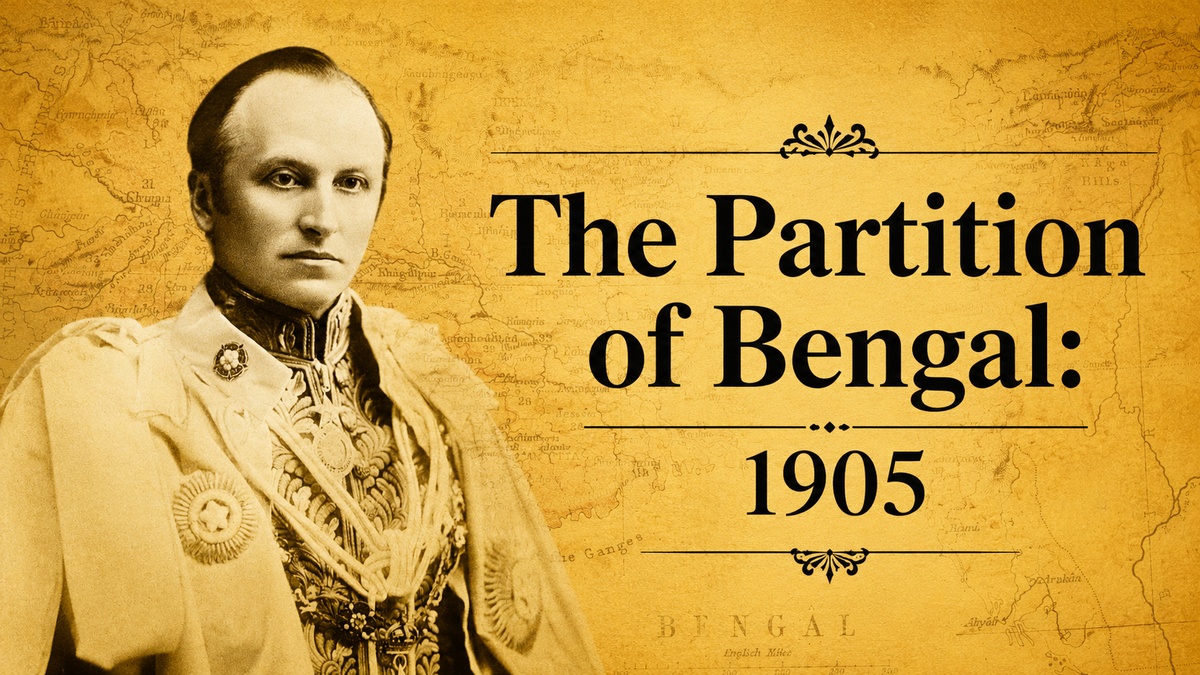
The Partition of Bengal in 1905 marked a decisive moment in the history of India’s anti-colonial struggle. This partition news announced by Lord Curzon, the Viceroy of India, the partition officially aimed to improve administrative efficiency in an excessively large province.
However, Indian nationalists widely interpreted the decision as an attempt to weaken political opposition through the colonial strategy of “divide and rule”, particularly by encouraging communal distinctions between Hindus and Muslims. The anti-partition movement subsequently transformed Indian nationalism, stimulated mass political participation, and gave rise to the Swadeshi and Boycott movements.
The Partition of Bengal, announced on 19 July 1905 and implemented on 16 October 1905 by the British Viceroy, Lord Curzon, remains one of the most significant events in the history of India’s freedom struggle. Officially presented as an administrative measure to improve governance, the partition was widely perceived by Indian nationalists as an attempt to divide the growing nationalist movement along religious lines. The event transformed Indian politics by giving rise to the Swadeshi Movement, strengthening nationalist consciousness, and marking the beginning of mass political mobilisation against British colonial rule.
Background of the Partition of Bengal
Before partition 1905, Bengal was the largest province in British India, covering present-day West Bengal, Bangladesh, Bihar, Odisha, and parts of Assam. According to the 1901 Census of India, the province covered nearly 189,000 square miles (about 490,000 sq km) with a population of approximately 78.5 million, making it one of the most populous administrative units in the British Empire. British officials argued that such a vast province was difficult to administer effectively.
Lord Curzon justified the partition on administrative grounds, claiming that smaller provinces would improve governance, revenue collection, law enforcement, and public administration. Under the new arrangement, Bengal was divided into the following:
- Eastern Bengal and Assam, with its capital in Dacca (Dhaka), had an estimated population of 31 million, of which about 18 million (approximately 58%) were Muslims.
- Western Bengal, with its headquarters in Calcutta (Kolkata), has a population of over 54 million, primarily composed of Hindus.
However, Indian leaders strongly rejected the government’s explanation. They argued that the real objective was the colonial policy of “Divide and Rule”, aimed at weakening the politically active Bengali middle class, which had become the centre of nationalist politics and intellectual activity. By separating the Muslim-majority eastern districts from the Hindu-majority western districts, the British hoped to reduce the influence of the Indian National Congress and discourage Hindu-Muslim political cooperation.
Before 1905, Bengal constituted the largest and most politically influential province in British India, comprising present-day West Bengal, Bihar, Odisha, and parts of Assam. With an estimated population of nearly 80 million, Bengal held immense administrative, economic, and intellectual significance. Calcutta served as the capital of British India and functioned as an important centre for education, journalism, literature, and political debate. The province also produced many reformers, intellectuals, and nationalist leaders, making Bengal the epicentre of anti-colonial political consciousness.
The British government justified the partition on administrative grounds, arguing that governing such a vast territory had become difficult. According to Curzon, dividing Bengal would improve governance, strengthen administrative efficiency, and promote development in neglected eastern districts. On 16 October 1905, Bengal was formally divided into two administrative units: Western Bengal and Eastern Bengal and Assam.
Nature of the Partition of Bengal
The reorganisation divided Bengal into a Hindu-majority western region, including Bengal, Bihar, and Odisha, while Eastern Bengal and Assam became a Muslim-majority province with Dacca (Dhaka) as its capital. Although officially administrative, Indian leaders believed that the real purpose of the partition was political. By separating religious populations and fragmenting Bengal’s political unity, the British sought to weaken the rapidly expanding nationalist movement and reduce the influence of educated Bengali elites.
The partition, therefore, came to symbolise the colonial strategy of divide and rule. Nationalists argued that the British deliberately attempted to create communal divisions between Hindus and Muslims in order to prevent unified political resistance against colonial authority.
Public Response and Nationalist Mobilisation
The Partition of Bengal generated intense resistance across India and became one of the earliest mass political agitations against British rule. Throughout Bengal and beyond, activists organised public meetings, demonstrations, and protest marches. On 16 October 1905, the day the partition came into effect, many Indians observed mourning rituals, closed shops and markets, and participated in symbolic acts promoting unity. The slogan “Vande Mataram” emerged as a powerful expression of nationalist sentiment. Prominent nationalist leaders played a crucial role in mobilising resistance. Leaders such as Surendranath Banerjee, Bal Gangadhar Tilak, Bipin Chandra Pal, Lala Lajpat Rai, and Aurobindo Ghosh transformed opposition to partition into a broader nationalist movement.
The agitation gradually spread beyond Bengal to regions such as Punjab, Maharashtra, and Madras, signalling the expansion of anti-colonial consciousness. One of the movement’s defining features was the participation of diverse social groups. Students boycotted government educational institutions; teachers and lawyers joined protest campaigns; women participated in demonstrations and the promotion of indigenous goods, while traders supported economic resistance against British products. This broad-based participation gave Indian nationalism a more popular and mass character.
Rise of the Swadeshi and Boycott Movements
The anti-partition agitation led directly to the emergence of the Swadeshi and Boycott movements. Swadeshi, meaning “of one’s own country”, encouraged Indians to reject foreign products and promote indigenous industries. British-manufactured goods, especially textiles, were publicly boycotted, and imported cloth was burnt in symbolic demonstrations. The movement stimulated economic nationalism by promoting Indian industries, handicrafts, textiles, banks, insurance institutions, and locally produced consumer goods. It encouraged economic self-reliance and generated awareness about the relationship between colonial exploitation and indigenous economic development.
The movement also initiated a National Education Movement. Students increasingly rejected government institutions, leading to the establishment of national schools and colleges aimed at fostering patriotic education and intellectual independence from colonial influence.
Simultaneously, the Swadeshi movement inspired cultural nationalism. Patriotic literature, songs, theatre, and public festivals became important vehicles for nationalist mobilisation. Rabindranath Tagore promoted social unity and cultural resistance through songs and symbolic campaigns. Nationalist consciousness expanded beyond political elites and entered everyday social life.
Annulment of the Partition of Bengal (1911)
Contrary to British expectations, the partition strengthened rather than weakened nationalist sentiment. Persistent protests and growing political unrest compelled the British government to reconsider the policy. In 1911, during the Delhi Durbar attended by King George V, the British formally annulled the partition and reunited Bengal. However, administrative reorganisation continued. Bihar and Odisha were separated from Bengal in 1912, while Assam was reconstituted as an independent administrative unit. Simultaneously, the capital of British India was shifted from Calcutta to Delhi. Historians interpret this decision partly as an attempt to reduce Bengal’s political significance and strengthen colonial administrative control.
Historical Significance
The Partition of Bengal occupies a pivotal place in India’s freedom struggle. It transformed nationalism from elite political discourse into mass political mobilisation, introduced economic resistance through Swadeshi and boycott, and deepened anti-colonial consciousness across regions and social groups. Although framed as an administrative reform, the partition was widely perceived as an example of colonial divide-and-rule politics that sought to weaken political unity through communal segmentation. Its long-term significance lies in demonstrating both the power of collective resistance and the dangers of identity-based political fragmentation. For students of Indian history, the episode remains essential for understanding the evolution of nationalist politics, colonial governance strategies, and the emergence of organised resistance in modern India.
Conclusion
The Partition of Bengal in 1905 marked a pivotal moment in the history of India’s nationalist movement and colonial governance. Although the British administration, under Lord Curzon, justified the division on grounds of administrative efficiency, Indian nationalists largely perceived it as a calculated attempt to weaken political unity and intensify communal distinctions through the policy of divide and rule. By separating Hindu-majority western Bengal from Muslim-majority eastern regions, the partition generated widespread political opposition and deepened anti-colonial consciousness across India.
More significantly, the anti-partition agitation transformed the character of Indian nationalism. It marked the emergence of mass political participation, involving students, women, professionals, traders, and ordinary citizens in organised resistance. The rise of the Swadeshi and boycott movements encouraged economic self-reliance, indigenous production, and nationalist mobilisation beyond elite political circles. Simultaneously, educational and cultural initiatives strengthened patriotic sentiment and promoted collective political awareness.
The eventual annulment of the partition in 1911 demonstrated the power of sustained public resistance against colonial authority. Historically, the Partition of Bengal remains important not only as an administrative episode but also as a defining moment that accelerated political awakening, strengthened organised nationalism, and exposed the divisive strategies employed by colonial rule in India.
(Dr Syed Mohammad Raghib completed his PhD from the School of International Studies, JNU, New Delhi.)
References
- Azad, Maulana Abul Kalam. (1960). India Wins Freedom; An Autobiographical Narrative. New York: Longmans, Green and Co.
- Bose, Nemai Sadhan. (1965). The Indian National Movement: An Outline. Calcutta: B.N. Bose Press.
- Brown, Norman, W. (1972). The United States and India, Pakistan, Bangladesh, Edited by Edwin O. Reischuer. Cambridge, Massachusetts: Harvard University Press.
- Das, Monmath Nath. (1982). Partition and Independence of India; Inside story of Mountbatten Days. Delhi: Vision Books.
- Gopal, Ram. (1967). How India Struggled for Freedom (A Political History). Bombay: The Book Centre.
- Khan, Yasmin. (2007). The Great Partition: The Making of India and Pakistan. New Haven: Yale University Press. India’s Struggle for Independence. New Delhi: Penguin Books, 1989.
- Modern India. Macmillan India, 1983.
- The Swadeshi Movement in Bengal, 1903–1908. People’s Publishing House, 1973.
- History of Modern India. S. Chand Publications.
- Government of India. Census of India 1901.
- The Cambridge History of India, Vol. VI. Cambridge University Press.