Historical Significance of Daudnagar and its Monuments: Ruining images reminding of old Glory
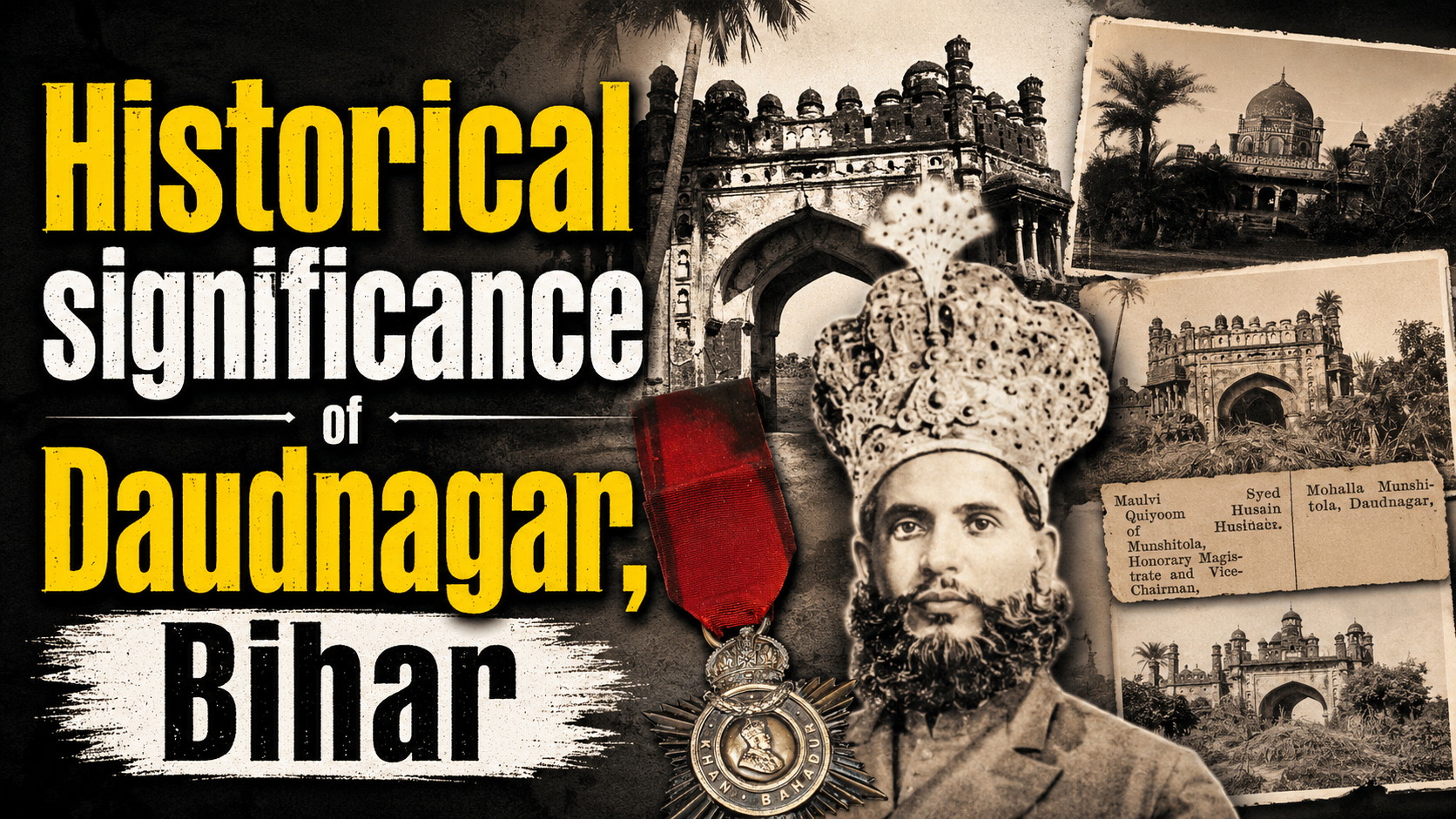
Daudnagar, a historic town in the Aurangabad district of Bihar, stands as a forgotten testimony to the rich political, economic, and cultural heritage of mediaeval India. Once a flourishing military cantonment and commercial centre during the Mughal period, Daudnagar today presents a contrasting image of neglected monuments and decaying architectural remains. The crumbling walls, abandoned gateways, ancient mosques, and ruined palaces scattered across the town silently narrate stories of power, prosperity, and strategic significance. These deteriorating structures serve as reminders of Daudnagar’s glorious past and underline the urgent need for heritage conservation. Daudnagar’s historical importance goes beyond just the town itself, showing its connection to larger changes in Mughal rule, trade in the region, and the development of architecture in eastern India.
Origins and Foundation of Daudnagar
The town derives its name from Daud Khan Quraishi, a distinguished Quraish noble and military commander under the Mughal Emperor Aurangzeb. Daud Khan was appointed Subedar of Bihar in the late seventeenth century and played an important role in consolidating Mughal authority in eastern India. He also attacked Rohtas Fort (Rohtasgarh) in 1660. Around 1696, he established Daudnagar as a military and administrative centre on the banks of the Son River. The 4,000 bighas of land in the Ancha, Goh, and Manaura parganas were granted to Daud Khan via an imperial Farman.[2] The selection of this location was not accidental. Situated along important trade routes connecting northern India with Bengal and the Deccan, Daudnagar occupied a strategic position for military movement and commercial exchange. The fertile plains surrounding the town further enhanced its economic importance like Rohtas Fort. Under Daud Khan’s patronage, the settlement quickly evolved into a fortified urban centre featuring administrative buildings, military barracks, markets, mosques, and residential quarters. The establishment of Daudnagar reflected the Mughal strategy of creating regional centres that combined military functions with revenue administration. Such towns served as instruments of imperial control while facilitating trade and agricultural production. Consequently, Daudnagar became an important node in the Mughal administrative network of Bihar.
Daudnagar as a Commercial Hub
During the eighteenth century, Daudnagar emerged as one of the most significant commercial centres in Bihar. Historical records indicate that the town became famous for its textile production, particularly cotton fabrics and handloom products. Merchants from Bengal, Uttar Pradesh, and other regions frequented the markets of Daudnagar, contributing to its economic prosperity. The town’s location near the Son River facilitated transportation and trade. Agricultural products from surrounding villages were brought to Daudnagar for distribution to larger markets. Grain, textiles, spices, and artisanal goods formed the backbone of the local economy. The flourishing commercial activities attracted diverse communities, including traders, artisans, soldiers, and religious scholars. The prosperity generated by commerce enabled the construction of numerous public buildings and religious structures. Wealthy merchants contributed to the urban landscape through charitable works and patronage of local institutions. As a result, Daudnagar developed a cosmopolitan character uncommon in many contemporary towns of Bihar.
Architectural Heritage of Daudnagar
One of the most remarkable aspects of Daudnagar’s historical significance lies in its architectural heritage. The town contains several monuments that reflect the synthesis of Mughal, Afghan, and regional architectural traditions. Although many structures are now in ruins, they continue to offer invaluable insights into the artistic and engineering achievements of the period.
One of the Gates of Daud Khan Fort
Chhoti Kila (The Fort)
The remains of the fort built during Daud Khan’s tenure constitute one of the most important historical landmarks of the town. Although large portions have deteriorated due to neglect and environmental factors, the surviving walls reveal the military architecture characteristic of the late Mughal era. Constructed using bricks and lime mortar, the fort once served as the administrative headquarters and military stronghold of the region. The defensive design included gateways, watchtowers, and fortified walls intended to protect the settlement from external threats. Today, only fragments remain, but they continue to evoke memories of Daudnagar’s strategic importance.
Ancient Gateways
Several old gateways scattered throughout the town represent significant examples of Mughal urban planning. These gateways once marked the entrances to important sections of the settlement and symbolised political authority and civic pride. The arches, decorative motifs, and masonry techniques visible in these structures demonstrate the high level of craftsmanship achieved by local artisans. Unfortunately, many gateways suffer from structural damage, vegetation growth, and encroachment, threatening their long-term survival.
biha
Eastern Gate of Daud Khan Fort
Source: Bihar Tourism Department
Historical Mosques
Daudnagar houses several historical mosques dating back to the Mughal period. These religious structures played a central role in the spiritual and social life of the community. Characterised by elegant arches, domes, and ornamental features, they represent important examples of Islamic architecture in Bihar. The mosques served not only as places of worship but also as centres of learning and community interaction. Islamic scholars, teachers, and students contributed to the intellectual life of the region through these institutions. Although some mosques remain functional, others have fallen into varying states of disrepair.
Picture of Mosque inside Fort of Daud Khan
Shamsher Khan Tomb
The Shamsher Khan (earlier he was Ibrahim, later entitled Shamsher) was nephew of Daud Khan, his Tomblocated at Shamshernagar near Daudnagar in Bihar’s Aurangabad district, is one of the region’s finest examples of early eighteenth-century Mughal funerary architecture. Built by Shamsher Khan, the Mughal governor of Bihar, before his death in 1712, the mausoleum reflects the elegance of Mughal design with its square plan, lofty dome, arched entrances, and finely ornamented façades. The Archaeological Survey of India protects the monument as a site of national importance. The tomb holds architectural significance and symbolises Daudnagar’s rich Mughal heritage, serving as an important historical landmark that attracts historians, archaeologists, and heritage enthusiasts.
Pictures of Shamsher Khan Tomb, Sahmshernagar (Daudnagar), Aurangabad (Bihar)
Residential and Administrative Structures
The remnants of old mansions, administrative buildings, and market complexes further illustrate the urban sophistication of historical Daudnagar. These structures reveal the lifestyles of officials, merchants, and elite families who once inhabited the town. Architectural features such as courtyards, decorative balconies, carved doorways, and ventilation systems reflect the adaptation of Mughal architectural principles to local climatic conditions. Their gradual disappearance represents a significant loss to India’s architectural heritage.
Daudnagar experienced significant changes during the decline of the Mughal Empire.
The decline of Mughal power in the eighteenth century profoundly affected Daudnagar. As central authority weakened, regional political instability disrupted trade and administration. The rise of local rulers, repeated conflicts, and changing economic patterns reduced the town’s strategic importance. Despite these challenges, Daudnagar continued to function as a regional commercial centre. However, the loss of imperial patronage gradually led to the deterioration of public infrastructure and administrative institutions and the major reason of destruction was Maratha army’s invasion of Bihar and Bengal in 1740. The fortunes of the town became increasingly dependent on local economic conditions rather than imperial support. The political fragmentation of northern India also altered traditional trade routes. New centres of power emerged, diverting commercial activity away from towns like Daudnagar. Consequently, economic decline contributed to the neglect of many historical structures.
Colonial Period and Changing Fortunes
The advent of British colonial rule introduced further transformations. Colonial administrative priorities often favoured newly developed urban centres connected by rail and modern transport networks. Daudnagar, which had flourished under earlier systems of trade and governance, found itself increasingly marginalised. Economic activities shifted toward colonial commercial centres, reducing the importance of traditional markets. While the town remained inhabited and economically active, it no longer occupied the prominent position it had enjoyed during the Mughal era. Many historical buildings suffered from lack of maintenance during this period. Some structures were repurposed, while others gradually fell into ruin. The absence of systematic preservation efforts accelerated the deterioration of architectural heritage.
The Ruining Images of a Glorious Past
Today, visitors to Daudnagar encounter a landscape marked by historical grandeur and visible neglect. Crumbling walls, damaged arches, broken domes, and weathered facades dominate many heritage sites. These ruins create a powerful visual contrast between past prosperity and present decay. The deteriorating condition of monuments reflects multiple challenges. Natural weathering, inadequate conservation measures, urban encroachment, and public indifference have collectively contributed to the decline of historical structures. In some cases, unauthorised construction has obscured or damaged heritage sites. Yet these ruins possess immense historical value. Their surviving architectural elements provide important evidence for understanding the social, political, and economic history of Bihar. The weathered monuments function as tangible links connecting contemporary generations with centuries of regional history. The ruins also evoke a sense of nostalgia and historical consciousness. They remind observers that cities and civilisations experience cycles of rise, prosperity, decline, and transformation. Daudnagar’s monuments stand as silent witnesses to these historical processes.
Cultural and Historical Importance
The significance of Daudnagar extends beyond architecture. The town represents an important chapter in Bihar’s contribution to India’s mediaeval and early modern history. Its association with Mughal administration, Afghan military elites, regional commerce, and cultural exchange makes it a valuable site for historical research. The heritage of Daudnagar illustrates the interconnected nature of political authority, economic development, and urban growth. The town demonstrates how regional centres contributed to the functioning of larger imperial systems while developing distinct local identities. Furthermore, Daudnagar reflects the multicultural character of Indian society. The coexistence of different communities, commercial groups, and religious traditions contributed to its social vitality. Preserving this heritage can promote greater understanding of India’s pluralistic historical legacy.
Pre-independence Daudnagar was an important Mughal-founded commercial town on the banks of the Son River. It was known for its landed families, merchants, hakims, religious scholars, and municipal leaders. Although detailed local records are limited, the following Muslims are among the best-known historical personalities associated with Daudnagar:
- Daud Khan: The Mughal military commander who founded Daudnagar in the late seventeenth century. The town derives its name from him, and he established it as an important military and commercial centre.
- Shamsher Khan: A prominent Mughal noble and governor of Bihar, whose mausoleum at Shamshernagar, near Daudnagar, remains one of the region’s most significant Mughal monuments.
- Khan Bahadur Syed Mohammad: A distinguished physician (hakim), philanthropist, educationist, and respected civic leader during the late nineteenth and early twentieth century’s. He was known for his charitable work, promotion of education, and public service and received the title “Khan Bahadur” during the British period.
- Ghulam Rasool Seth: One of Daudnagar’s leading businessmen and benefactors. He was associated with the town’s commercial prosperity and contributed to charitable and religious activities.
- Syed Imdad Imam: Although not a resident of Daudnagar itself, he was an eminent jurist, scholar, and educationist from the wider Aurangabad region who influenced the intellectual life of south Bihar.
- Maulvi Mohammad Abdul Ghafoor: He is remembered locally for his contributions to Islamic education and religious instruction before independence.
- Hafiz Abdul Karim: A respected Qur’anic scholar associated with local madrasas and mosque education in the early twentieth century.
In addition to these individuals, Daudnagar had several influential Muslim families, including the Syed, Sheikh, Pathan, and Ansari communities, who played important roles in trade, Unani medicine, municipal administration, education, and religious life before 1947.
Challenges of Heritage Conservation
Despite its historical importance, Daudnagar receives relatively little attention from conservation authorities and heritage organisations. Many monuments remain undocumented, while others lack adequate protection. Financial constraints, administrative limitations, and insufficient public awareness further complicate preservation efforts. Conservation experts emphasise the necessity of systematic surveys, restoration projects, and heritage management plans. Community participation is equally important, as local residents play a crucial role in safeguarding historical assets. Educational initiatives can help foster appreciation for the town’s cultural heritage among younger generations. Tourism development, if carefully managed, could provide additional incentives for preservation. Heritage tourism has the potential to generate economic benefits while increasing public awareness of Daudnagar’s historical significance. However, such initiatives must balance economic objectives with conservation priorities.
Conclusion
Daudnagar occupies a distinguished place in the historical landscape of Bihar and India. Founded by the Mughal commander Daud Khan Quraishi, the town emerged as a significant military, administrative, and commercial centre during the late seventeenth and eighteenth centuries. Its forts, mosques, gateways, and residential structures collectively reflect a rich legacy of political authority, economic prosperity, and cultural interaction. Today, the ruined monuments of Daudnagar present a poignant image of lost grandeur. Their crumbling walls and fading architectural details remind us of a vibrant past that once shaped regional history. Far from being mere relics, these monuments are invaluable historical resources that deserve recognition and protection. Preserving Daudnagar’s architectural and cultural heritage is not only a matter of safeguarding physical structures but also of honouring the historical memory of a town that once stood as a symbol of power, commerce, and civilisation in eastern India.
References:
Alam, Muzaffar and Subrahmanyam, Sanjay (2012), Writing the Mughal World: Studies on Culture and Politics, Columbia University Press.
Francis, Robinson, “Writing the Mughal World: Studies on Culture and Politics by Muzaffar Alam and Sanjay Subrahmanyam”, Journal of the Royal Asiatic Society, Third Series, Vol. 22, No. 2, (April 2012) pp. 479-482.
Hasan, Syed Askari and Qeyamuddin Ahmad (edit), Comprehensive History of Bihar, Vol. 2 Pat 2, Publised under the Patronage of the Government of the State of Bihar, 1974.
Heritage Times, URL: https://www.heritagetimes.in/?s=Aurangabad#google_vignette
Heritage Times, URL: https://www.youtube.com/watch?v=Yeh7UuWPVBA
Raghib, Syed Mohammad (2026), Hakeem Khan Bahadur Syed Mohammad of Daudnagar: A Life of Service, Leadership and Legacy, MJS Publishing House, Lucknow.(Forthcoming)
Richard, J.F, (1975), Mughal Administration in Golconda, Clarendon Press, Oxford.
The Journal of the Bihar and Orissa Research Society, 1945, Vol. XXXI, Internet Archive, URL: https://archive.org/stream/in.ernet.dli.2015.283319/2015.283319.The-Journal_djvu.txt
Tourism Department, Government of Bihar, URL: https://tourism.bihar.gov.in/hi/destinations/aurangabad/daud-khan-fort
[1] Dr Syed Mohammad Raghib completed his PhD from the School of International Studies, JNU, New Delhi.
[2] The Journal of the Bihar and Orissa Research Society, 1945, Vol. XXXI, Internet Archive, URL: https://archive.org/stream/in.ernet.dli.2015.283319/2015.283319.The-Journal_djvu.txt