The Professor, the Prisoner, the Philosopher: Rediscovering Anilbaran Roy
Beyond Gandhi and Bose lies the story of a Bengal leader who built local resistance, inspired modern Indian art, and envisioned India’s global mission.
The history of Indian nationalism is often told through its most recognisable names. Mahatma Gandhi, Chittaranjan Das, Subhas Chandra Bose, Sri Aurobindo and others occupy large spaces in the story. Around them, however, worked a much larger group of teachers, organisers, writers and local activists whose lives connected national politics with the institutions and people of colonial India.
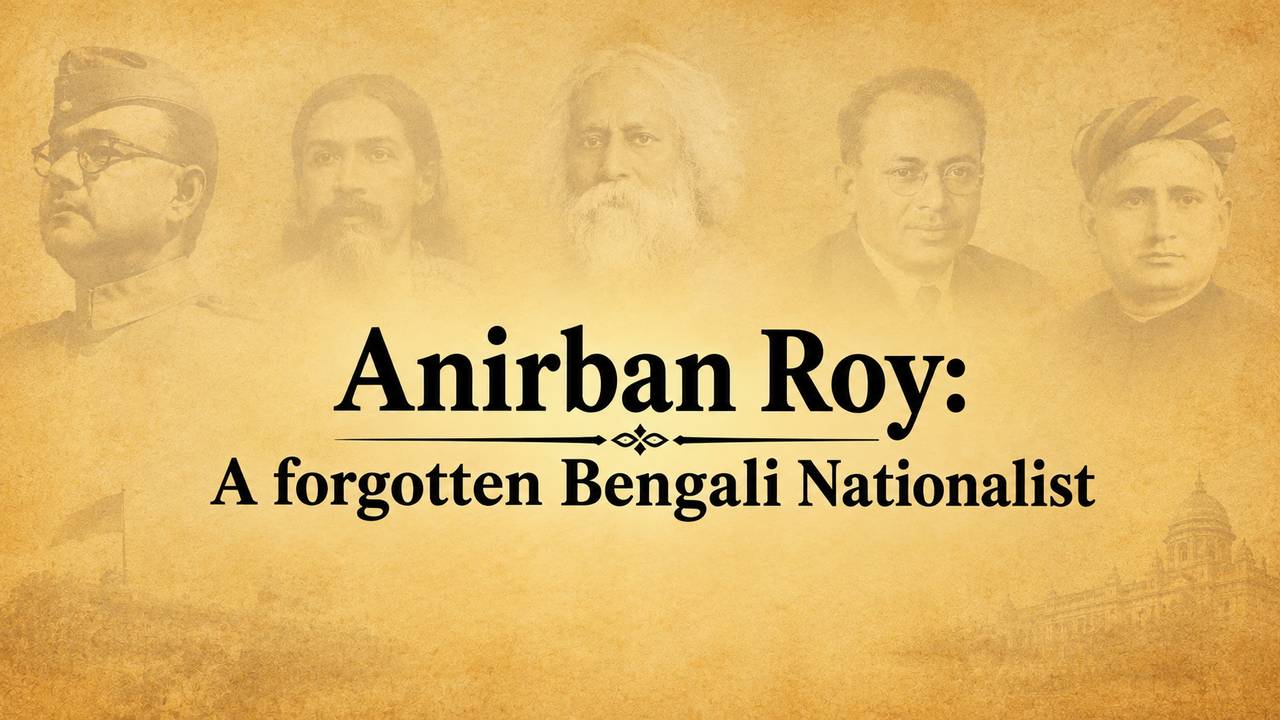
Anilbaran Roy was one of them.
Born at Guir in the Burdwan district on 3 July 1890, Roy was educated in Calcutta. He studied at Scottish Church College and St Xavier’s College and later obtained M.A. degrees in English and Philosophy and a Bachelor of Law degree from the University of Calcutta. Before entering politics, he taught philosophy, first at Hetampur College in Birbhum and later at Bankura Wesleyan College now known as Bankura Christian College.
In 1921, during the Non-Cooperation Movement, Roy left teaching and entered nationalist politics. He subsequently became associated with Chittaranjan Das and the Bengal Provincial Congress Committee. His transition from philosophy professor to political organiser placed him within the changing nationalist politics of Bengal in the early 1920s.
Grassroots Nationalism: Organising Resistance in Bankura
Bankura provides an especially useful place from which to understand this part of his life. Nationalism did not simply move from Calcutta into the districts as a finished programme. It had to be organised through schools, meetings, associations and local political networks.
An account published in Anandabazar Patrika describes Roy as one of the pioneers of Gandhian politics in Bankura. After leaving his college position, he helped establish a national school and became the first secretary of the Bankura District Congress.
The importance of this local activity becomes clearer when another name enters Roy’s story: Ramkinkar Baij.
Ramkinkar would later become one of the major figures of modern Indian sculpture, but his adolescence in Bankura coincided with a period of intense political activity. Accounts of his early life record his involvement in nationalist work and his close association with Roy.
Sumita Chakraborty’s study of Ramkinkar records some of these activities, including posters depicting Bharat Mata, a sick child and a prisoner. The young artist was therefore encountering politics not only through speeches and meetings but through visual work.
This small connection between a political organiser and a teenage artist offers a different view of how nationalism functioned outside the major political centres. Political communication was not confined to speeches, newspapers and resolutions. Images and posters also helped carry political ideas into public spaces. A young artist could participate in the movement through the work of his hands.
It would be misleading to attribute Ramkinkar’s later artistic development to Roy. His mature career belonged to a very different artistic world and had many influences. What the evidence does show is that, during his adolescence, his artistic ability was being used in nationalist political activity and that Roy was one of the people who encouraged this connection.
From District Mobilisation to the Legislative Council
Roy’s political career soon extended beyond this local setting. His association with Chittaranjan Das brought him into the politics of the Swarajya Party. In the 1923 elections he contested the Bankura West constituency and was elected to the Bengal Legislative Council. By then he had moved from district-level organisation into the wider political network of Bengal’s Swarajists.
The extent of his political position is visible in Subhas Chandra Bose’s The Indian Struggle, 1920–34. Describing the colonial government’s arrests of Swarajist leaders on 25 October 1924, Bose named Anil Baran Roy and S. C. Mitra, among the prominent Swarajist members of the Bengal Legislative Council who were arrested along with Bose.
Bose explained that the government had decided to imprison principal organisers of the Swaraj Party without trial under the powers provided by Regulation III of 1818 and the Bengal Ordinance. In a footnote, he added that Roy had subsequently retired from politics and joined Sri Aurobindo’s Ashram at Pondicherry.
The arrest came during a period when the Swarajists were challenging colonial authority through legislatures, local institutions and political mobilisation. Roy was therefore part of the organised political opposition that the colonial government sought to suppress in Bengal.
Prison, however, altered the direction of his life.
From Colonial Prison to Pondicherry: The Spiritual Pivot
During his imprisonment Roy became increasingly interested in Sri Aurobindo’s writings. After his release in 1926, he went to Pondicherry and joined Sri Aurobindo’s Ashram.
The transition is sometimes presented simply as a movement from politics to spirituality. Roy’s earlier training as a philosopher and his political experience make the change more interesting. The questions surrounding India, freedom and national life did not disappear. They were increasingly considered in philosophical terms.
Roy’s later writings show that he was interested in nationalism as more than a programme for political independence. His India’s Mission in the World, published in 1931, placed India’s national development within a larger conception of India’s place in human civilisation. His other writings and translations continued to explore Indian philosophy, Sri Aurobindo’s thought and the future of humanity.
This is an important part of Roy’s intellectual identity. He did not treat the nation as an isolated political unit. His writings connected India’s national awakening with questions of culture, civilisation and human development. Nationalism, in this framework, had a historical purpose beyond the acquisition of state power.
His recorded conversations with Sri Aurobindo also provide evidence of the intellectual environment in which these questions were being discussed. Roy’s surviving records of conversations with Sri Aurobindo cover questions of politics, nationalism, culture, education, religion and the future of humanity. These records should not be treated as simply Roy’s own philosophy, but they help illuminate the intellectual world in which his later thought developed.
Science vs. Tradition: The Debate with Meghnad Saha
His intellectual concerns eventually brought him into an important controversy with the physicist Meghnad Saha.
On 13 November 1938, Saha delivered a lecture at Santiniketan that was later published in Bharatbarsha under the title ‘A New Philosophy of Life.Saha discussed India’s social and economic condition, industrial development and the role of science and technology, while also questioning aspects of India’s religious and philosophical inheritance.
Roy responded in Bharatbarsha. Saha subsequently replied, producing a wider exchange over science, religion and claims concerning India’s intellectual traditions. The surviving record shows that the exchange continued through a series of replies and rejoinders in Bharatbarsha during 1939 and 1940.
The controversy was more than a disagreement between a scientist and a spiritual thinker. It raised a question that had troubled Indian intellectuals for decades: how could India become modern while deciding what, if anything, should be retained from its intellectual inheritance?
Saha’s answer emphasised scientific and technological development. Roy defended the philosophical resources of Indian civilisation against what he regarded as an overly dismissive interpretation of them. The disagreement therefore reveals something about Roy’s philosophy of history. For him, India’s past was not simply an object of historical memory. It was connected to the question of India’s future.
This also helps explain why Roy’s career moved across several different worlds. He was a philosophy professor who left teaching during Non-Cooperation. He became a political organiser in Bankura, worked within the circle of Chittaranjan Das and entered the Bengal Legislative Council.
Roy was arrested with prominent Swarajists in 1924. He then entered Sri Aurobindo’s intellectual world and spent decades writing about India, philosophy and civilisation.
Why Anilbaran Roy’s Legacy Matters Today
His life therefore connects several worlds that are often separated in histories of modern India: political nationalism and philosophy, provincial organisation and intellectual culture, nationalist communication and art, political imprisonment and spiritual thought, science and debates over India’s past.
There is no need to turn Roy into a forgotten “great man” in order to make his history worthwhile. His value lies in the connections his life reveals.
Through Bankura, we see how nationalism had to be built locally. Through Ramkinkar, we see how political ideas could enter visual culture. Through the Bengal Legislative Council and his imprisonment, we see Roy’s place within the Swarajist challenge to colonial rule.
And through his later writings and controversy with Saha, we encounter a deeper question: what did national freedom mean if the nation itself was understood as part of a larger historical and civilisational process?
Roy died in 1974. By then, the political world in which he had begun his career had disappeared, and his name had become far less familiar than those of the leaders with whom he once worked.
Yet his life remains useful precisely because it does not fit neatly into one story.
To recover Anilbaran Roy is not simply to add another name to the history of Indian nationalism. It is to look again at the teachers, organisers, artists and thinkers through whom nationalism was actually lived, and at the ideas about history and India’s future that continued to shape their lives after the political struggle itself had changed.
References
Bose, Subhas Chandra. The Indian Struggle, 1920–34. London: Wishart & Co., 1935.
Anandabazar Patrika. “বাঁকুড়ায় গাঁধীবাদী রাজনীতির পুরোধা ছিলেন অনিলবরণ রায়.”
Chakraborty, Sumita. “রামকিঙ্কর বেইজ : প্রতিভার স্বতন্ত্র উদ্ভাস.” Parichay, Vol. 78, Issues 7–12.
Sri Aurobindo Archives. “Personalia: Anilbaran Roy.”
Roy, Anilbaran. India’s Mission in the World. Calcutta: Hindu Mission, 1931.
Roy, Anilbaran. The Message of the Gita, as interpreted by Sri Aurobindo.
Roy, Anilbaran. Sri Aurobindo’s Talks of 1926. Recorded by Anilbaran Roy.
Roy, Anilbaran. Interviews and Conversations with Sri Aurobindo and the Mother.
Saha, Meghnad. “A New Philosophy of Life.” Bharatbarsha, Vol. 26, 1938. Reproduced in Sushil Kumar Mukherjee, ed., The Scientist in Society, pp. 93–96. Kolkata: Thema, 2010.
Roy, Anilbaran. “Rejoinder.” Bharatbarsha, Vol. 26, 1939. Reproduced in Sushil Kumar Mukherjee, ed., The Scientist in Society, pp. 97–106. Kolkata: Thema, 2010.
Saha, Meghnad. “Rejoinder to the Rejoinder: 1.” Bharatbarsha, Vol. 26, 1939. Reproduced in Sushil Kumar Mukherjee, ed., The Scientist in Society, pp. 107–116. Kolkata: Thema, 2010.
Saha, Meghnad. “Rejoinder to Rejoinder: 4.” Bharatbarsha, Vol. 27, 1940. Reproduced in Sushil Kumar Mukherjee, ed., The Scientist in Society, pp. 137–144. Kolkata: Thema, 2010.
(Rajat Kanti Satpati is the author of several books and an independent researcher writing on history, political thought, literature, and the Indian freedom movement. He has a particular interest in local history and holds a master’s degree in History. His academic interests include the literature and history of the American West, classical literature, and the novels of the American westward movement.)
(The ideas and views expressed here are personal to the author and do not represent the ideology of The Heritage Times)